TAKING
RESPONSIBILITY TOGETHER
HERISTO CLEARLY COMMITS TO CLIMATE PROTECTION

The heristo Group is aware of its responsibility towards the environment and climate. A key objective is to significantly reduce the environmental impact of its business activities – particularly greenhouse gas emissions. To establish a baseline, detailed CO2 balances were prepared for all company locations for 2022, documenting the current status and serving as a benchmark for future targets.
At the end of 2022, the entire group of companies joined the Science Based Targets initiative (SBTi). This internclimate protection organization supports companies in developing scientifically sound targets for reducing greenhouse gases. These targets are based on the latest findings in climate research and make a significant contribution to limiting global warming. In April 2025, heristo 's climate targets were officially confirmed.
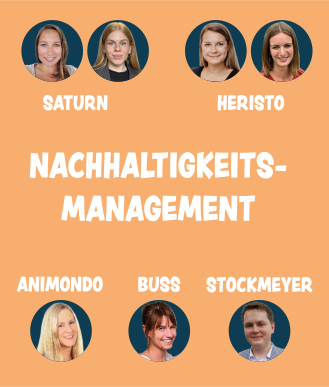

SATURN PETCARE: SÖNDRA BRAND, ANNIKA LEHNIG HERISTO: ISABEL BORN, VICTORIA RAHE ANIMONDA: JEANNINE FELLHÖLTER BUSS: MAITA BENGSCH STOCKMEYER: KAI BIESS
“The confirmation of our climate targets by the Science Based Targets initiative is a great success,” explains Isabel Bron, Sustainability Manager at heristo. “We want to achieve ambitious goals in the coming years. Some measures can be implemented quickly, while others require time and a shift in thinking. Reducing greenhouse gases is a long-term process – and a task we are happy to take on.”
A significant step in this direction is the procurement of green electricity at the European locations. Furthermore, the heristo companies Buss, Stockmeyer , and saturn petcare in Bremen have developed transformation concepts, the first steps of which are currently being reviewed and implemented.
Climate targets at a glance: By the end of 2025:
For primary raw materials associated with deforestation, the goal is to eliminate deforestation.
By 2029:
At least 50% of suppliers pursue their own scientifically based climate targets. This applies to all products and services that are purchased.
By 2034 (compared to 2022):
Reduction of direct and indirect greenhouse gas emissions at the sites around 58,8 %.
Reducing emissions along the entire supply chain – from production and transport to raw materials – to 58,8 %.
Reduction of emissions from forestry, agriculture and farming by 42,4 %.

The confirmation of our climate targets by the Science Based Targets initiative is a great success.